




- March 4, 2025
- by NCS Global
- 5mins read
US Federal Tax Brackets 2025 with Income Tax Rates & Tips
As 2025 approaches, taxpayers across the United States are gearing up to file their taxes and, for many, understanding how the federal tax brackets 2025 apply to their situation is a top priority. Whether you’re filing as an individual, a family, or a business owner, understanding the 2025 federal income tax rates is essential for financial planning. In this blog, we’ll break down the tax brackets, highlight any significant changes, and share tips to help you manage your taxes efficiently.
What Are Federal Tax Brackets?
Before diving into the federal income tax brackets, it’s essential to understand what tax brackets are and how they work. The U.S. has a progressive tax system, meaning your income is taxed at different rates depending on how much you earn. This is calculated using marginal tax rates—essentially, the rate that applies to each portion of your income within specified brackets.
For example, if you’re in the 24% tax bracket, only the portion of your income above the 22% bracket threshold is taxed at 24%. Each year, the IRS adjusts these brackets for inflation to ensure taxpayers are not pushed into higher brackets simply due to rising wages.
For 2025, the brackets have increased by approximately 2.8%, offering some relief amid rising living costs. For instance, the standard deduction for single filers has increased to $15,000 from $14,600 in 2024. Seeking professional tax compliance services can help ensure that you’re making the most of these adjustments while staying within regulatory guidelines.
Federal Tax Brackets 2025
The 2025 federal income tax rates reflect adjustments for inflation, which the IRS makes annually to ensure taxpayers are not unfairly impacted by rising costs of living. Below is a breakdown of the tax brackets for 2025 based on your filing status:
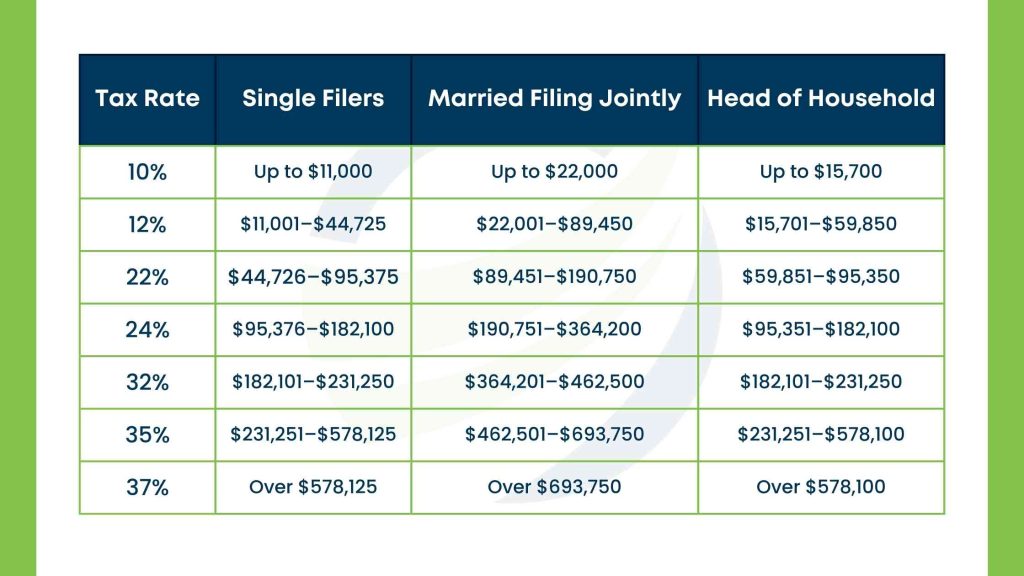
These IRS tax rates 2025 apply to taxable income, which is your total income minus deductions and exemptions.
Inflation Adjustments and Other Tax Updates
Apart from federal tax brackets 2025, here are other notable changes for the tax year:
- The estate tax exemption has increased to $13.99 million, offering significant relief for wealth transfers.
- The annual gift tax exclusion has risen to $19,000, providing more room for tax-free gifts.
- Contributions to Health Savings Accounts (HSAs) have increased to $4,300 for individuals, helping taxpayers save on healthcare costs.
Looking ahead, discussions about the United States 2026 tax brackets suggest that some provisions from the 2017 Tax Cuts and Jobs Act (TCJA) may expire, potentially impacting rates and thresholds. However, for now, taxpayers should focus on what’s confirmed for 2025.
How Federal Income Tax Brackets Work in Practice
Let’s break this down with an example:
- Single Filer with a taxable income of $60,000:
- The first $11,000 is taxed at 10%.
- The next $33,725 ($11,001–$44,725) is taxed at 12%.
- The remaining $15,275 ($44,726–$60,000) is taxed at 22%.
This results in a marginal tax rate of 22%, but the effective tax rate (total tax divided by total income) is much lower due to the progressive structure.
Tips to Optimise Your Tax Filing in 2025
Navigating the federal tax brackets 2025 doesn’t have to be daunting. Here are some strategies to help minimise your tax burden:
1. Maximise Your Deductions
- Take advantage of increased contribution limits for 401(k)s, IRAs, and HSAs to reduce taxable income.
- Take advantage of itemised deductions if they exceed the standard deduction.
2. Leverage Tax Credits
Unlike deductions, credits directly reduce the amount of tax you owe. Popular options include:
- The Child Tax Credit
- The Earned Income Tax Credit
- Education-related credits for tuition and other expenses
3. Manage Your Bracket
- If you’re close to crossing into a higher bracket, consider deferring income to the following year or accelerating deductible expenses to lower your taxable income.
4. Keep an Eye on the Future
While the IRS tax rates 2025 provide clarity for now, staying informed about potential changes to the United States 2026 tax brackets can help you plan longer-term strategies.
Common Misconceptions About Federal Income Tax Brackets
It’s common for taxpayers to think that earning more will push their entire income into a higher bracket. However, as explained earlier, only the portion of income within a specific bracket is taxed at that rate. This progressive system ensures fairness while still encouraging higher earnings.

Tax Planning for Small Businesses
Small business owners face unique challenges but can also benefit from thoughtful tax planning. Key strategies include:
- Deducting Business Expenses: Office supplies, equipment, and even a home office may qualify.
- Timing Income and Expenses: Shift income to a different year or accelerate expenses based on your expected income and bracket.
- Staying Compliant: Regularly review your financial records to avoid errors or missed deductions.
Consulting with a business tax advisory service can be invaluable for small business owners, ensuring compliance with IRS regulations while identifying opportunities for savings.
Looking Ahead: What to Expect Beyond 2025
While 2025 brings clarity with inflation-adjusted brackets, the question of what happens next remains open. The expiration of provisions from the 2017 Tax Cuts and Jobs Act (TCJA) could lead to changes in the Trump tax brackets 2025 and beyond. Keeping an eye on legislative developments is crucial for long-term planning.
Understanding federal income tax brackets and the 2025 federal income tax rates can make a huge difference in how you manage your money. By knowing how deductions, credits, and timing strategies work, you can reduce what you owe and keep more of your earnings.
Whether you’re filing as an individual or as a business owner, staying informed and planning ahead will always pay off. And if things get complicated or you’re unsure, reaching out to a tax professional for outsourced tax preparation who understand your needs can make a real difference
who understand your needs can make a real difference
FAQ’s
1. What are the federal tax brackets for 2025?
Federal tax brackets for 2025 are based on a progressive tax system. Rates range from 10% to 37%, with income thresholds adjusted for inflation. These brackets vary depending on your filing status (e.g., single, married, or head of household).
2. How do federal income tax brackets work?
Federal tax brackets apply progressively, meaning different portions of your income are taxed at different rates. For example, only the income exceeding a lower bracket threshold is taxed at a higher rate, ensuring fairness in the system.
3. Will tax rates change in 2025 compared to 2024?
The IRS tax rates for 2025 remain largely unchanged, but income thresholds have been adjusted for inflation. This means some taxpayers may remain in lower brackets despite modest income increases.
4. What are the “trump tax brackets 2025”?
The term refers to tax brackets influenced by the 2017 Tax Cuts and Jobs Act under the Trump administration. While these brackets are still in effect, they may revert to pre-2017 rates after 2025 unless new legislation is passed.
5. Are federal tax brackets different for businesses?
Federal income tax brackets apply only to individual taxpayers. Businesses, especially corporations, follow separate tax rules, including a flat federal corporate tax rate of 21%, not tied to income brackets.
6. What is the difference between marginal and effective tax rates?
Your marginal tax rate is the highest rate applied to your income, while the effective tax rate is the average rate you pay on your total taxable income. The effective rate is lower due to the progressive system.